What Are Finances for Kids? The 3 Ideas Every Parent Should Know
Money for kids means the basic ideas about money a child can learn: earning, spending, saving and deciding. They're taught through stories and practice, not complicated numbers, and for a parent the real question is always the same: where do I start and how do I know it's working? Here's a path of three ideas.
How to do it: one idea per week
The three ideas from Ploutus Lab's first class are a good starting point:
- Income: money you receive for doing something.
- Debt: borrowed money that has to be paid back.
- Risk: every money decision can turn out well or badly.
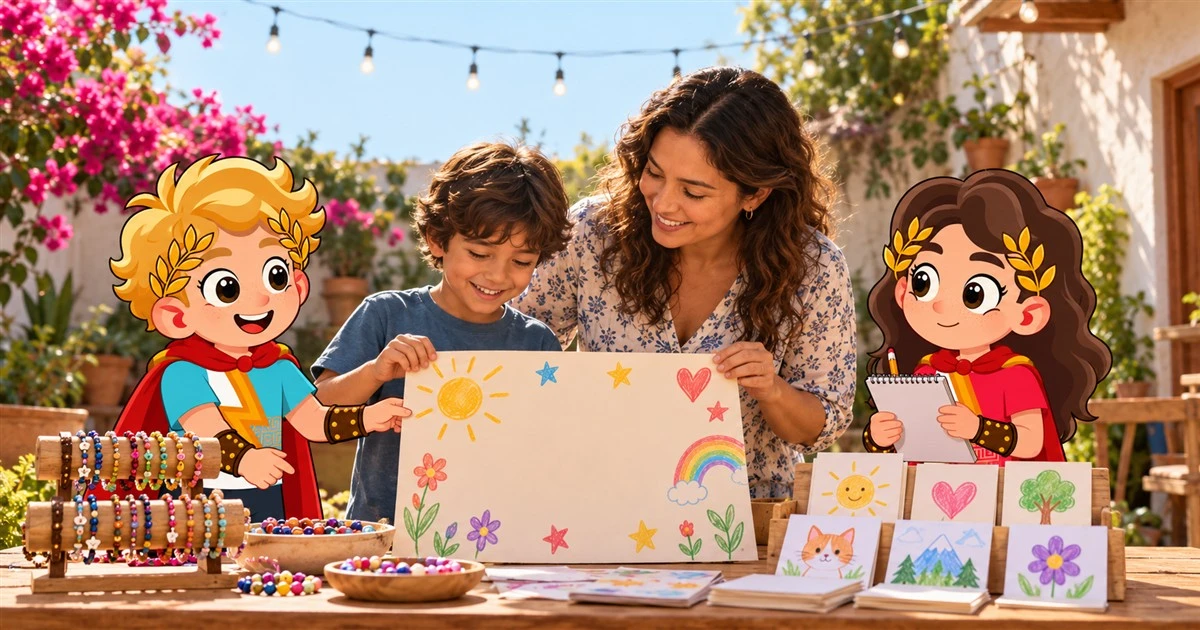
Each week, name one idea with an example from your home. Income: "You earned three dollars because you helped wash the car. That's income." Debt: "Your brother owes you the toy until Sunday." Risk: "If you make bracelets and nobody buys them, you lost your time; if they do, you won. That's risk." End with one question: "What example can you think of?"
What it's for
For your child: it puts names on things they already live and gives them a vocabulary of their own. They feel capable, not dumb: a child who says "that's a risk" feels part of the conversation. For you: you stop explaining "money" as an enormous topic and shrink it to one sentence a week, which eases the anxiety of "I don't know how to teach this."
What the research says
Ron Lieber (The Opposite of Spoiled) argues for talking about money with kids from an early age, naturally. Fletcher and Wright (2024) developed measures of financial understanding for children aged 4 to 6, which shows the topic can be studied and built from that age, and found a relationship with conversation at home. Berti and Bombi (The Child's Construction of Economics) show that children assemble these ideas gradually, so repeating them helps.
What you'll see over time
- First weeks: they use the new words, sometimes wrongly, and apply them to their games.
- Three to six months: they name incomes, debts and risks in daily life without being asked.
- Long term: an early vocabulary of money is the foundation for understanding budgets, loans and investing later; nothing needs deciding now, just leaving the door open.
Signs it's working
They use "income," "debt" or "risk" on their own; they ask more specific questions ("and if it doesn't work out?"); and they offer examples of their own. If nothing happens, you're explaining too much: go back to one idea and one question.
Recognize income, debt and risk as basic ideas.
Give everyday examples for each idea.
Talk about money naturally at home.
"We think before we decide with our money."
Most common error