Passive vs. Active Screens: How to Tell Them Apart at Home
Not all screen time is the same. Watching something nonstop is different from doing something with what you see. That difference helps you decide without guilt.
How to tell them apart at home
- Passive: watching without responding, videos that play one after another. The child receives without deciding.
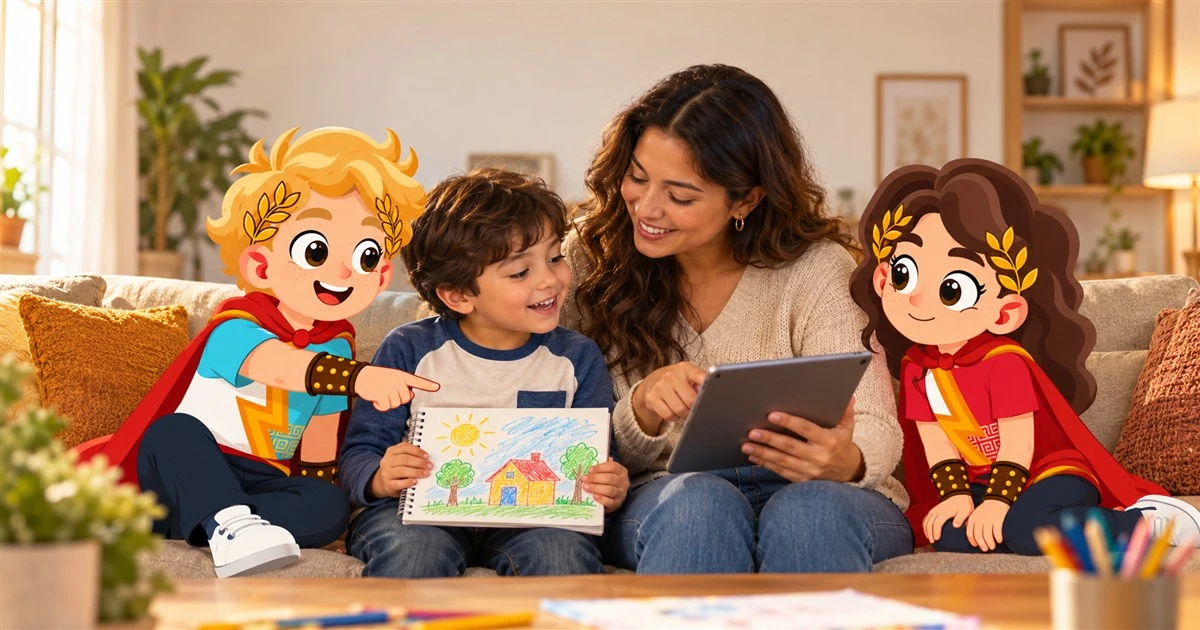
- Active: choosing, answering or doing: a game that asks for decisions, a story that asks "what would you do?", content that ends and leads to another activity.
Three quick tests: ask "What did you decide in that?" (if there's no answer, it was probably passive); check for an ending (content with a clear end is easier to put down); and combine with something physical afterward: drawing, cutting, building.
What it's for
For your child: active screen time works their attention and their ability to choose; passive leaves them wanting "more." They feel capable when they decide something. For you: you replace the guilt of "is it too much?" with a two-question criterion, and avoid a total ban, which usually creates more fights.
What the research says
The American Academy of Pediatrics (Media and Young Minds, 2016) recommends, for ages 2 to 5, up to one hour a day of quality programming watched with an adult, and stresses content quality more than the clock. Nir Eyal (Hooked) shows how autoplay is designed to keep us going; a clear ending breaks that inertia.
What you'll see over time
- First weeks: they choose content that ends and let go with less protest.
- One to three months: they tell what they saw and suggest what to do next.
- Long term: a relationship with screens based on choosing, not consuming, which is also the base of deciding with money.
Signs it's working
After the video they want to do something; if they want more of the same without stopping, it's time to change the routine and set the limit before the next one. It's not about removing screens, but about choosing better what comes in.
Tell apart receiving content from deciding with it.
End screen time with a hands-on activity.
Explain what they watched and what they decided.
"Watching is one thing, deciding is another."
Most common error