Printable Money Worksheets: How to Use Them as a Family
A printable sheet brings the lesson to the table. The child writes, draws, matches or sorts, and in doing so fixes the idea. Brown, Roediger and McDaniel, in Make It Stick, explain that producing an answer, even an imperfect one, teaches more than reading one already solved. The sheet's value lies in who does it and what's talked about afterward; a sheet without conversation stays paper.
How to do it
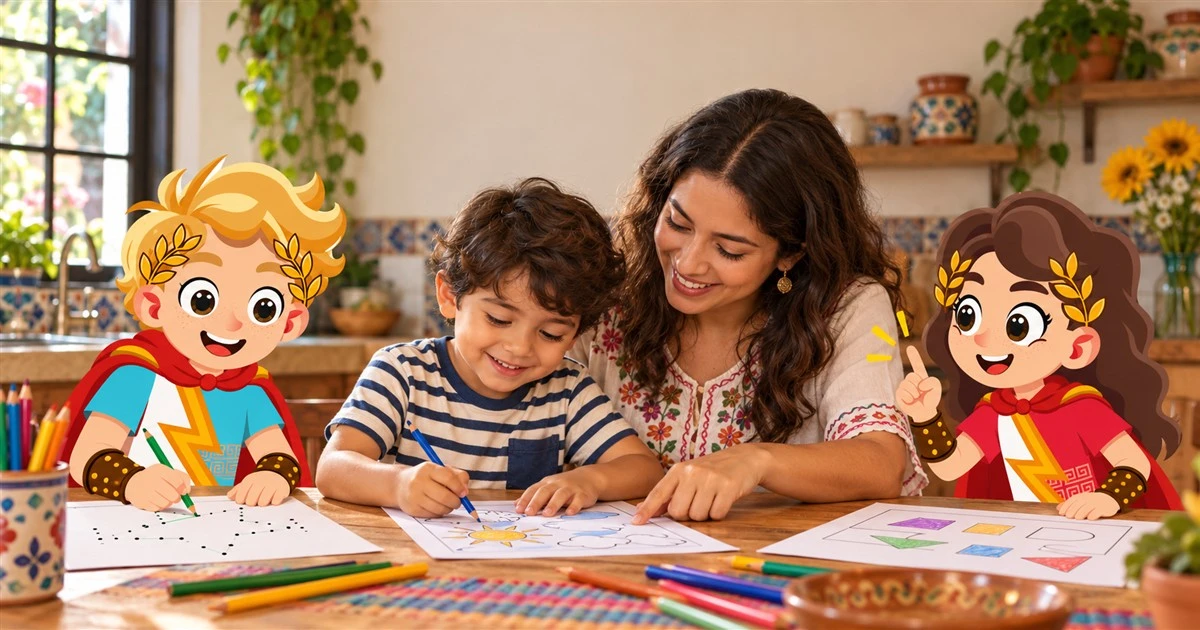
Using it is simple: print the sheet for their age, read the instructions together and ask what they understand. Let them do most of it while you accompany, and at the end ask why they chose that answer.
What it's for
For your child, the sheet is a space where they can make mistakes and redo the answer without anyone pointing it out. For you, the sheet stops being a task to check, because what you review is the reasoning behind it.
What the research says
When there's a mistake, you don't correct it out loud. You ask how they got to that answer. Carol Dweck, in Mindset, shows that children who see mistakes as information keep trying, and those who see them as failure stop taking risks.
What you'll see over time
In the first weeks the child may ask you to tell them the answer. That's when it helps to ask what they think it is and why. Between one and six months, keeping the sheets in a visible folder lets you see progress: Teresa Amabile and Steven Kramer, in The Progress Principle, describe that noticing progress is among what motivates people most. In the long run, with a date on each sheet, you can compare the first with the last and see how much their way of thinking has changed.
Signs it's working
You know it's working when the child explains their answer without being asked, when they correct something on their own and when they ask for the next sheet. With several children, each has their own range of sheets: the older one can help the younger one read the instruction, and both talk about their answer.
Understand that a mistake is information to keep trying.
Practice money ideas with paper and pencil.
Explain their answer without being asked.
"A sheet without conversation only leaves paper."
Most common error