Money Workbooks for Kids: What a Good One Should Include
A good money workbook makes the child produce an answer, not just color. It should have activities for their age, questions to talk about and a guide for the adult. If after a page they can't explain anything, the workbook is just entertainment.
How to do it
Before buying, flip through three random pages and look for action verbs: sort, match, order, choose, compare, complete. If it's almost all coloring, keep looking. Check the age: at 5, single-idea activities with drawings; at 9, comparisons and small problems. Look for the parent guide, with one question per activity.
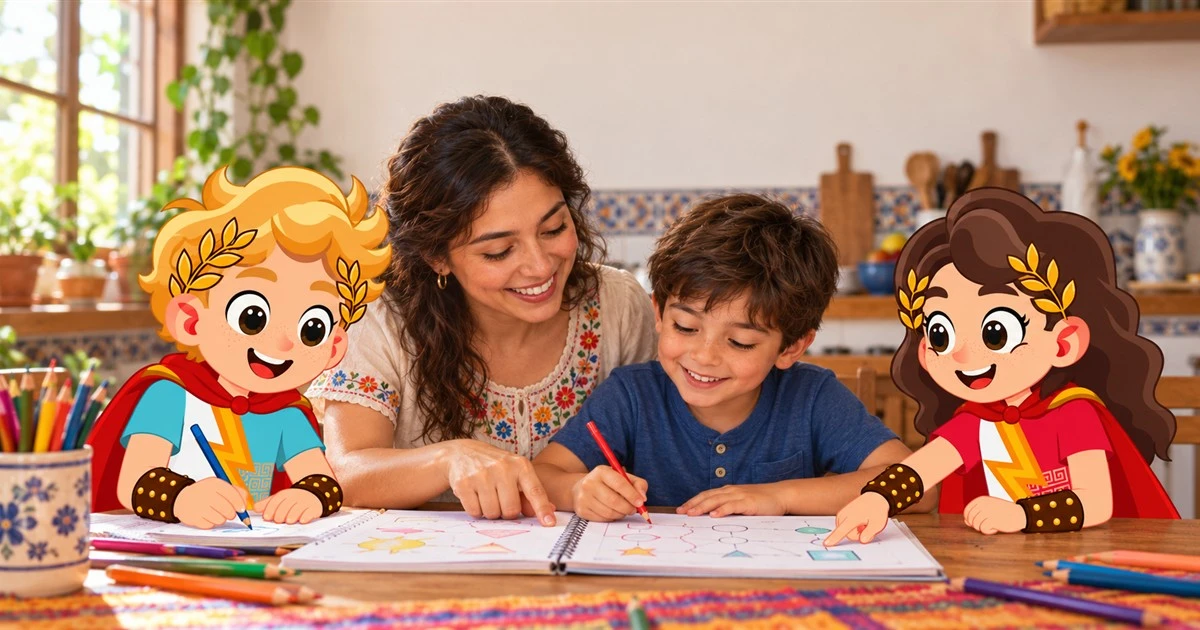
At home, do one activity a week with your child beside you. Before moving to the next, ask: "Explain to me why you put that here." It's better to measure value per activity, not per page: ten useful activities are worth more than fifty pages of color. An example: an activity asks them to match five things with "I need" or "I want," and the child matches the toy with "I need." You don't correct; you ask what would happen if they didn't have it.
What it's for
For your child, practicing with their hands what they've heard gives security. They feel capable when they finish an activity and can explain it. For you, you know what they understood without giving them a test, and the page gives you the topic for conversation.
What the research says
Brown, Roediger and McDaniel, in Make It Stick, describe the generation effect: producing an answer, even an imperfect one, fixes learning better than reading one already done. Berti and Bombi (1988) show that economic understanding moves from the concrete to the abstract, which is why activities start with objects the child knows.
What you'll see over time
In the first weeks they want to finish fast and choose at random; ask for one explanation per activity. Between one and six months they take their time and discuss their answers with you. In the long run they apply the activity to real life and, for example, sort the grocery cart without being asked.
Signs it's working
It's working when they explain their answers, when they remember an activity days later and when they ask for the next page. If they get bored, change the time of day or move to another type of activity.
Understand that producing an answer teaches more than coloring.
Do one money activity each week.
Explain an answer in their own words.
"A useful workbook ends in conversation."
Most common error
Try it here too
To practice at home: the workbook Be a Real Hero has financial literacy activities. https://a.co/d/0g6BVfUK